- What is Copyright?
One of the biggest myths about copyright is that you must “apply” with the U.S. Copyright Office in order to receive copyright protection. In actuality, a copyright exists as soon an idea is in a tangible form. The textbook definition of copyright refers to a legal concept, enacted by the government, which gives the creator of an original work a group of exclusive rights to the work, usually for a limited number of years.
In order for a work to be copyright protected it must 1) be an original work, 2) a work of authorship and 3) fixed in a tangible form. Matter that is protectable include works of literature, music, drama, architecture, pictorials, graphics, sound recordings and sculpture.
 All of the works that have copyright are represented with one of two symbols. The first being the designated circled “C”which is the symbol used in copyright notices for all works mentioned in section 102 of the copyright act other than sound recordings. This symbol indicates that the publishers/composers of the music own the compositions. The second symbol that designates whether a matter is copyrighted or
  not is the circled “P.” This is the used in copyright notices to provide notice of copyright in sound recording (phonogram) and indicates that the labels/artists are the ones who own the sound recordings.
- What rights are granted to artists and songwriters?
Artists and songwriters are granted six exclusive rights:
- Reproduction – right to reproduce the copyrighted work (applies to sound recording and composition)
- Derivative work – right to prepare derivative works based on copyrighted work (applies to sound recording and composition)
- Distribution – right to distribute copies to all public (applies to sound recording and composition)
- Public Performance – right to perform copyrighted works publicly (applies to composition ONLY)
- Public Display – right to display copyrighted works publicly
- Public Performance – right to perform work publicly by means of a digital audio transmission (sound recording ONLY)
Master rights: the right of the actual “master” sound recording, owned by the record label and/or artist. When copying a sound recording, a license from the rights holders is required.
Mechanical rights: the right of the author, composer and publisher of the musical composition, the song’s music and lyrics, referred to legally as the “underlying composition.”
Performance rights: the right to publicly perform a musical composition that includes live performances as well as the use of any form of music player, including but not limited to, an mp3 or CD player or any form of broadcast, such as AM/FM or satellite radio.
- The Copyright Office and registering works
The U.S. Copyright Office maintains public records of all copyrighted material that has been filed. The Office’s registration system and the companion recordation system constitute the world’s largest database of copyrighted works and copyright ownership information. It also provides basic copyright information services such as copyright searches.
There are two main benefits of registering work through the U.S. Copyright Office. Registration establishes public record of the copyright claim enabling others to view the works as well as keeping infringement claims from being made until a work is completely registered.
How do you register your work?
The first step is going to the U.S. Copyright Office website www.copyright.gov/eco. This page provides many downloadable resources, guides and tutorials to help with the process of registering. If registering for compositions, use the Form PA located at the bottom of the page. If registering for sound recordings and/or compositions embodied in the same sound recording, use Form SR.
The cost to file your registration electronically (recommended) is generally $35-$55 with an estimated processing time of up to 8 months. Filing paper forms generally takes up to 13 months to process and is harder to track the status of the application.
- What is publishing?
Publishing is the contractual relationship between a songwriter or music composer and a music publisher, whereby the writer assigns part or all of his/her music copyrights to the publisher in exchange for the publisher’s commercial exploitation of the music.
The roles of a publisher vary but can be simplified into 3 main categories:
- Nurture songwriters. Publishers can introduce other songwriters for collaboration opportunities as well as helping maintain and foster the growth of the artist.
- Exploit songs. Publishers have a say on album cuts and sync placements.
- Admin of catalog and rights. Registering copyright, conducting agreements with co-writers and notifying sub-publishers are all ways a publisher protects the artist. They also issue licenses for mechanical, sync, print and other media uses as well as collecting and distributing royalties earned from licenses.
-
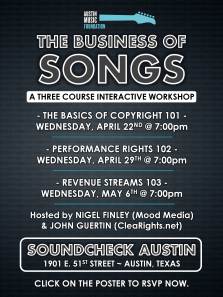 This was the first of a three course workshop that will continue to build knowledge on the business of music throughout the next two workshops. Austin Music Foundation thanks Nigel Finley and John Guertin for hosting and putting together the content provided in these workshops. We hope to see you at the next meeting! If you have any questions feel free to email [email protected].